Imagine a strategy as a suspiciously complicated espresso machine.
There is a grind dial, a temperature dial, a pressure dial, a dose dial, and one unlabeled switch that may or may not do anything. You change everything at once, taste the coffee, and decide the machine has opinions.
That is not analysis yet. That is button weather.
To understand the machine, you need to know which controls matter. Does temperature change the result? Does grind size only matter at high pressure? Is the unlabeled switch decorative, ceremonial, or quietly responsible for every disaster?
A parameter sweep creates the trading version of that problem. Influence is built to answer it.
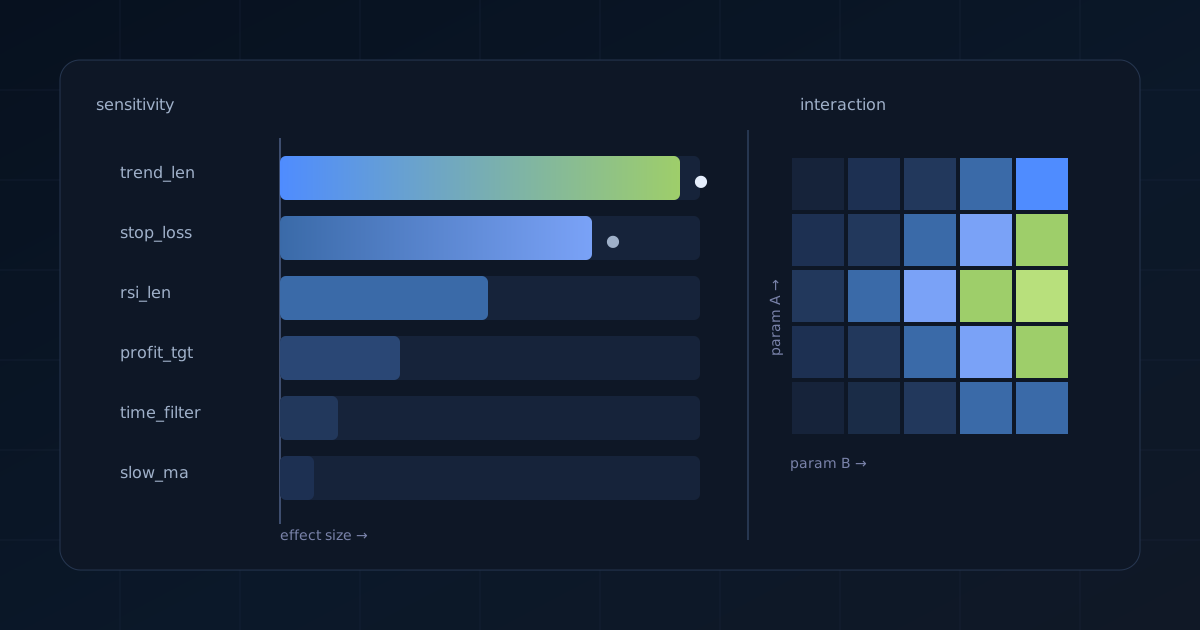
It explains which inputs move the outcomes, which inputs barely matter, and where two inputs combine to create a pattern neither one explains alone.
Reading a parameter sweep
When you run a batch test, every row is a small experiment:
- Set the parameters.
- Run the backtest.
- Record the metrics.
After a large sweep, you might have thousands of experiments. Understanding why the results changed matters more than finding the best row.
If return improves when a trend filter length gets longer, that matters. If drawdown gets worse when a stop becomes too loose, that matters. If win rate barely changes across an input, that input may not deserve much attention.
Influence starts with sensitivity analysis: estimating how much the output changes when an input changes.
Main effects: one knob at a time
The simplest influence question is:
When this parameter changes, what tends to happen to the metric?
That is a main effect.
Suppose we tested a trend filter length from 50 to 250. Influence can group those values into bins and compare the metric distribution inside each bin.
| Trend length bin | Median return | Median drawdown | Median trades |
|---|---|---|---|
| 50-90 | 8% | 31% | 82 |
| 91-130 | 18% | 27% | 64 |
| 131-170 | 34% | 22% | 48 |
| 171-210 | 39% | 20% | 37 |
| 211-250 | 36% | 19% | 28 |
This tells a story. Longer trend filters appear to improve return and reduce drawdown up to a point, but they also reduce trade count.
That does not prove causation in a scientific sense. A batch sweep is still historical testing. But it gives the researcher a strong clue about where to look next.
Grouping parameter values into bins
Raw parameter values can be too granular.
If a sweep tests every moving average length from 10 to 300, looking at each exact value can produce a noisy comb of results. Binning turns exact values into ranges, then compares those ranges.
This is called binned conditional expectation.
That phrase sounds like it arrived wearing a lab coat, but the idea is friendly:
For rows where the parameter landed in this range, what did the metric tend to be?
For example:
- For
stop_lossbetween 1.0 and 1.5, what was median drawdown? - For
rsi_lengthbetween 10 and 14, what was average return? - For
trend_lengthbetween 180 and 220, what share of rows beat the benchmark?
The bins smooth out row-level noise while keeping the relationship visible.
Flat lines narrow the search
A parameter that does not matter is not a disappointment. It is a gift.
If changing a threshold across a wide range barely affects return, drawdown, or trade count, then the researcher has learned something. That input may be simplified, fixed, or moved lower in the investigation.
This is especially helpful when a strategy has many controls. Too many parameters make every research step harder:
- More combinations to test.
- More ways to overfit.
- More settings to explain.
- More places for a fragile result to hide.
Influence can help separate the knobs that deserve close attention from the knobs that are mostly along for the ride.
The next sweep can then be smaller and cleaner.
Interactions: when two knobs form one pattern
Main effects are powerful, but they can miss the most interesting part.
Sometimes one parameter only matters because of another.
For example, a stop loss might look unimportant overall. But when paired with a short trend filter, tight stops may destroy performance. When paired with a long trend filter, the same stops may barely matter.
That is an interaction effect.
| Trend length | Stop loss 1.0-1.5 | Stop loss 1.6-2.5 | Stop loss 2.6-4.0 |
|---|---|---|---|
| 50-100 | -12% | 4% | 9% |
| 101-160 | 6% | 22% | 24% |
| 161-220 | 18% | 41% | 39% |
| 221-280 | 14% | 33% | 29% |
Looked at alone, stop loss might seem mildly helpful. Looked at together with trend length, the pattern is clearer: tight stops struggle when the trend filter is short, while the middle stop range works well in the stronger trend-length bands.
Influence uses pairwise heatmaps for this kind of question. One parameter forms the rows, another forms the columns, and the cell values summarize the metric.
Look at the distribution
It is tempting to look only at the average metric in each bin. Averages are useful, but they can be gullible.
One enormous outlier can lift an average and make a bin look healthier than it is. Influence is more useful when it lets the researcher compare distributions: median, quartiles, pass rate, sample count, and spread.
Two bins can share the same average return but mean very different things:
| Bin | Average return | Median return | Pass rate | Interpretation |
|---|---|---|---|---|
| A | 30% | 28% | 72% | Broadly healthy |
| B | 30% | 4% | 19% | Lifted by outliers |
Bin B is the classic trap. The average looks fine, but most rows failed. Bin A is more trustworthy because the median and pass rate agree with the average.
Influence shows how metric distributions change across parameter ranges.
Decisions Influence can support
Influence is especially useful before you choose what to inspect deeply.
It can help answer:
- Which parameter should I plot first?
- Which input can I stop worrying about?
- Where does performance change sharply?
- Which pair of parameters should I study together?
- Are my good results coming from a stable range or one strange bin?
Without influence analysis, a researcher may choose axes based on habit: return against drawdown, fast length against slow length, win rate against trade count. Those views can be useful, but they may miss the parameters that explain the movement.
Influence gives the batch a first pass at identifying which parameters explain the movement.
From an Influence result to the next test
A weak conclusion sounds like this:
“The best result used a trend length of 210.”
A stronger influence-aware conclusion sounds like this:
“Trend length has a strong main effect on return and drawdown. Results improve sharply from the 100-160 bin into the 160-220 bin, then flatten. Stop loss has a weaker main effect, but it interacts with trend length: tight stops perform poorly when the trend filter is short.”
It suggests the next test:
- Narrow the trend length range around the stable area.
- Keep stop loss flexible enough to study the interaction.
- Drop or fix parameters that showed little influence.
- Inspect representative rows from the healthiest bins.
What Influence can and cannot show
Influence makes a large sweep easier to understand. It shows which parameters move the metrics, where the movement changes, and when two parameters need to be considered together. It does not establish causation or show that a pattern will persist in live markets.